
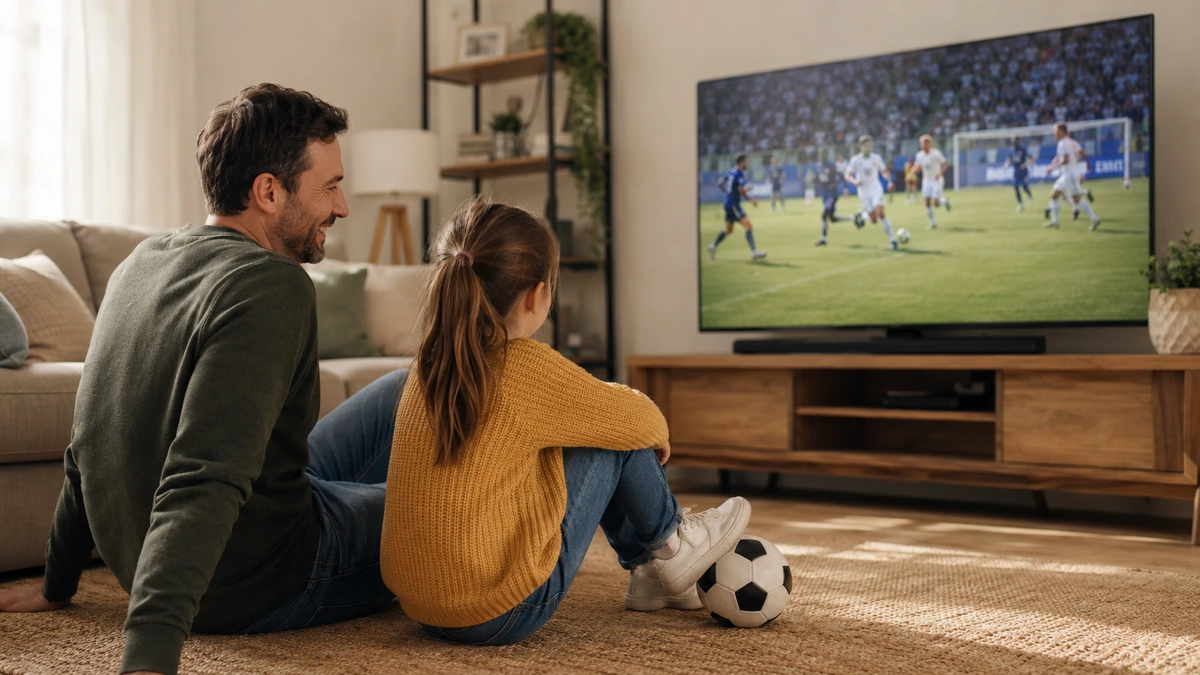
Soccer's biggest tournament is the perfect spark to get your kids familiar with the game. Use the live experience to get your child familiar with soccer and introduced to basic dribbling skills.
Key Takeaways
- The tournament itself is great to watch together; the skill-building happens when you pair it with a ball at your child's feet.
- Watch in short bursts, then practice one touch: soft taps with the inside of the foot, keeping the ball close.
- Aim for active screen time: watch a few minutes, then get up and move.
- Explain the game as it's going on. Tell your child the history of the teams and why the event matters. Competence breeds confidence.
For a few weeks every cycle, soccer is everywhere: on the TV, on phones, in the neighborhood. A major global soccer tournament is on, and your kid is suddenly interested. That excitement is the easiest on-ramp into the sport you'll get all year. The trick is turning "watching soccer" into "doing soccer."
This is a top-of-funnel guide for exactly that. For the full age-by-age plan, head up to our soccer pillar, How to Teach Soccer to Kids, by Age. For this specific age range, see Teaching Soccer to 4–6 Year Olds.
LudoLogic Sports is our company, and Global Trophy Trek is our soccer series, where the Guardians travel the world collecting skills with Coach Lola, the "Big Sister" mentor, as their guide — which makes a global soccer summer the perfect time to start.
What can my kid watch during soccer's biggest tournament that actually teaches soccer?
The matches themselves are a great watch for a young child in small doses. Point out players controlling the ball with the inside of the foot and keeping it close. But "watching that teaches" means pairing it with doing: a few minutes of a game, then a few minutes with a ball at her feet.
Passive watching entertains; watch-then-practice is what builds skill.
What the research says
Little kids are built to move, not to sit. The World Health Organization recommends at least 180 minutes of physical activity across a 3–4 year old's day and less than an hour of screen time, according to its 2019 guidance. So the tournament works best as a spark for movement, not a reason to sit longer.
How do I turn watching soccer into real skills at home?
Use a simple watch-then-do rhythm: watch a few minutes of a match, pause, and copy one thing you saw with a ball at her feet. Keep it to a single skill: soft taps with the inside of the foot, keeping the ball close.
Three or four pairs of rolled-up socks work fine indoors, and shoes come off so she can feel the ball.
A loop that works
- Watch 5–10 minutes together. Narrate one idea: "See how they keep the ball close?"
- Pause and practice one touch. Soft inside-of-the-foot taps; the ball should barely move. Our step-by-step is here: First Soccer Touch, Inside of the Foot.
- Make it a tiny game. Can she dribble across the rug without the ball getting away?
- Stop while it's still fun. Five good minutes beats a forced twenty.
What worked in our house
My wife and I both played Division I basketball, so big games are on a lot in our house. What I learned with my five-year-old is that she doesn't want to watch for long — but she loves to copy, and she gets into it when we do. So we stopped trying to make her sit through a whole match and started doing "one move from the game," then going right back to playing.
The watching became the warm-up, not the event. What really gets her going is the suspense — those few seconds when a goal might be coming — so we lean into it, holding our breath right along with her. And when a goal actually happens? It's like a birthday party in our living room: jumping, screaming, the whole thing. That buzz is exactly what sends her looking for a ball the second the celebration's over.
What soccer videos for kids actually build skills, not just entertain?
The best soccer videos for kids get them up and moving with a ball, teach one skill at a time, and give a clear cue a parent can repeat. Plenty of popular kids' movement channels are fun and worth a watch, but most are general activities, not a soccer curriculum.
Look for videos that name a specific touch, show it slowly, and ask your child to try it.
What we believe
In plain terms, physical literacy is the foundation of movement skills, confidence, and motivation that lets a child enjoy being active for life, as defined by Sport for Life. We believe a tournament should be a doorway to that, not a couch session. A few real touches your child can pull off will do more for her love of the game than a whole match she half-watches. Build the skill, and the fandom takes care of itself.
What soccer skills can my kid do at home during the tournament?
At 4–6, stick to ball control she can win at: softly tapping the ball with the inside of the foot, dragging it back with the sole, and keeping it close while she walks. Skip passing to a target and shooting on goal for now.
The goal this summer is simple: she can touch the ball and keep it at her feet.
Common Mistakes and Quick Fixes
- Long sit-down viewing. Fix: watch in short bursts and get up to move between them.
- Trying to teach passing and shooting because that's what's on TV. Fix: keep it to control: touch and keep the ball close.
- Comparing her to the pros. Fix: celebrate one good soft touch. That's the real win at this age.
Quick safety note
Use a clear safe space, soft household props, and active supervision for young kids. Stop for pain, dizziness, or distress. Consult a qualified professional for medical concerns.
FAQ
How much of a big soccer tournament is okay for a young child to watch?
Keep it short and active. A young child does best with brief viewing broken up by movement, in line with WHO guidance to limit screen time and keep little kids active. Watch a few minutes, then go practice a touch.
My kid only wants to watch, not play. How do I get her moving?
Make the ball part of the show. Keep a soft ball nearby, and at every break challenge her to copy one thing from the match. Lowering the bar to a single, doable touch usually flips "watching" into "playing."
CTA
Want a soccer summer that actually teaches? Global Trophy Trek takes your child around the world, one skill per stop. Start with the free first episode, Global Trophy Trek Episode 1, or explore the full Global Trophy Trek series.
About the author
Lincoln Gunn is the Founder & CEO of LudoLogic Sports. He and his wife are both former Division I basketball players, and they're raising two young daughters. LudoLogic Sports' mission is to give every kid a better, more joyful start in sports — "build the ultimate athlete, not the elite basketball player" — using a play-based curriculum grounded in physical-literacy research. Read more on Lincoln's author page.
Sources
- World Health Organization — To grow up healthy, children need to sit less and play more (2019): https://www.who.int/news/item/24-04-2019-to-grow-up-healthy-children-need-to-sit-less-and-play-more
- Sport for Life / IPLA — What is physical literacy?: https://physicalliteracy.ca/physical-literacy/