
Key takeaways
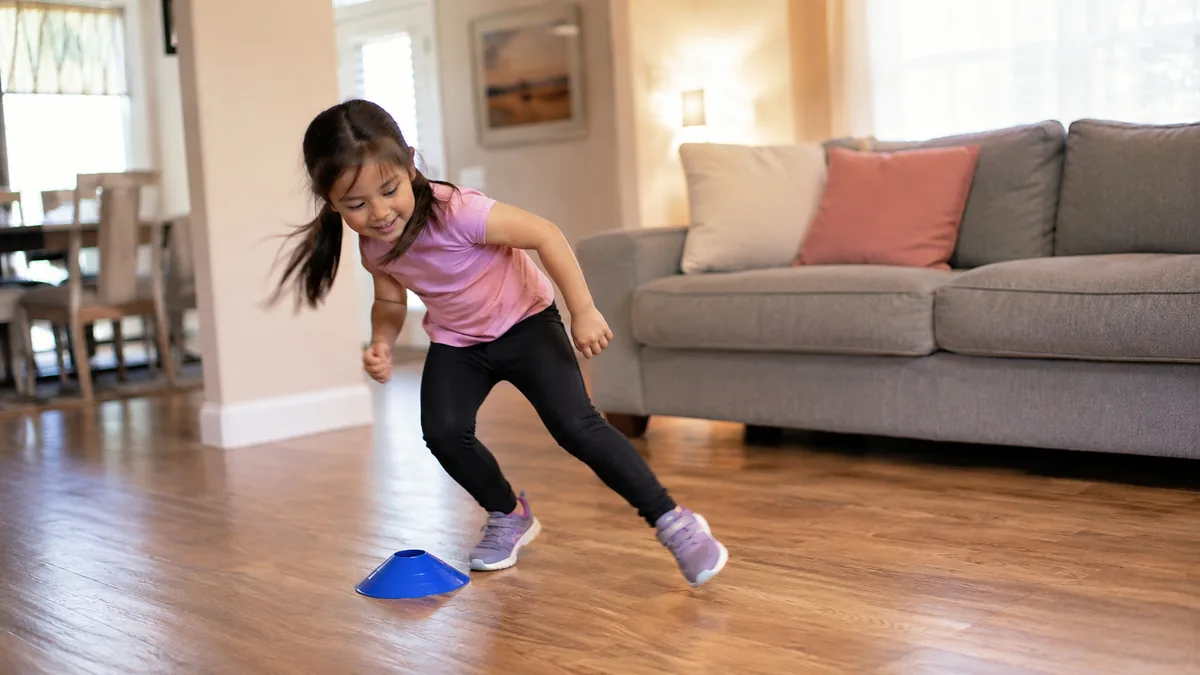
- Agility at 4-6 is about body lean, not foot speed: to turn left, she dips her left, or inside, shoulder and leans into the turn — the same move a base runner uses to round a base.
- One cue is enough: "dip your inside shoulder and lean, like an airplane banking its wing" — plus a soft marker, or four soft markers to build a square.
- Change of direction is a foundational movement skill built in the 2-8 window, so this is exactly the age to start.
Your daughter can run in a straight line just fine. Then she reaches the couch, tries to turn, and either wipes out or runs three steps too far before swinging back around. You're not imagining it — turning while running is a separate skill from running, and almost nobody teaches it on purpose at this age.
In plain terms: agility for a 4-to-6-year-old means changing direction under control — turning, cutting, and stopping without falling. The whole skill comes down to one move at this age: dipping the inside shoulder and leaning into the turn, so the body steers instead of the feet. The good news is you don't need cones, a field, or any athletic background to teach it. You need a hallway, something soft to run around, and a single cue she can remember.
A quick note on names you'll see below: LudoLogic Sports is our company, Rainbow Riders is our video series, and Coach Kenzie — the kids know her as "Stable Master Kenzie" — is the guide your child rides along with. The skill in this guide, running corners and rounding the bases, is the focus of our Episode 2 adventure, The Storm Dragon, and I'll show you how the episode teaches it so you can run the same play at home.
Agility is one piece of the broader early-movement map. For the full progression, see our full guide to daily movement for 4-6 year olds.
Quick facts for practicing at home
- Age: 4-6
- Skill: Agility — running corners and changing direction, the foundation of base running
- Time needed: 10-15 minutes
- Equipment: To learn the lean, just clear floor space. For the full challenge, use 4 soft markers such as pillows, stuffed animals, or rolled towels to build a square.
- One cue: "Dip your inside shoulder and lean into the turn — like an airplane banking its wing." In the episode, Coach Kenzie calls it the "Dragon Lean."
- Safety check: Clear a space bubble at least two arms wide around the turning zone — no hard furniture corners. Pick up loose toys, use grippy shoes or bare feet so she does not slide out, supervise young kids, stop for pain, dizziness, or distress, and consult a professional for medical concerns.
Why does my child run past the turn instead of cutting around it?
Young kids run past turns because turning while running is a separate skill from running in a straight line, and it only develops once the body learns to slow down and redirect. At ages 4-6 that ability is brand new, so overrunning the corner is completely normal. It's a sign she's ready to learn the lean — not that anything is wrong.
What the research says
Changing direction is one of the fundamental movement skills — the building blocks that come before any sport. These skills are learned in a predictable window from roughly ages 2 to 8, which is why coaches call this period the foundation for everything that follows, per the National Strength and Conditioning Association's guidance on long-term athletic development. Running fast in a straight line and turning under control are two different abilities. At 4-6, the turning one is brand new, so overrunning the corner is normal — her body has not learned to slow and redirect yet.
For the broader evidence base behind this movement-skills series, see the fuller sources list on our movement skills page.
What worked in our house
My oldest is five, and for about a week she overran every single turn — on purpose, I'm pretty sure, because the crash was the fun part. The fix was not telling her to "slow down." It was giving her a reason to change directions. I had her pretend she was the Storm Dragon dipping a wing to bank around a cloud — and, because we were getting her ready for her first softball practice, we framed it as learning to round the bases. The second the turn became a shoulder dip instead of a stop-and-pivot, she stopped flying past it. Kids do not turn well when they're thinking about their feet. They turn well when they're thinking about their shoulders, with their eyes up and looking where they're going.
What age should kids start practicing agility and change of direction?
Around age 4 is a great time to start, and the broader window for building fundamental movement skills runs from about ages 2 to 8. You don't need formal training, cones, or a program — at this age, change of direction is best taught through short, playful sessions of leaning into turns, with form always coming before speed.
The reason to start early is that early childhood is a useful window for building motor patterns through play and repetition. The goal is not to make a 4-year-old fast; it is to teach control. Keep sessions to 10-15 minutes, stop before her form gets sloppy, and treat every clean lean as the win. Speed can come later once the body knows how to steer.
What worked in our house
We started with a silly game: wiggle your shoulders like you're dancing — get them moving forward and back, then up and down. Then we added airplane wings, with arms out in a T, to exaggerate the lean so she could really feel it: pretend you're an airplane flying through the sky. From there we layered in movement — leaning while standing still, then marching, then finally running. It's a progression that builds up to the run.
This is exactly the build Coach Kenzie uses in the Storm Dragon episode, and it works because each stage adds only one thing. One cue only — resist stacking three corrections.
How do I actually teach the turn? Step by step
Teach the turn in four stages: first practice a static shoulder lean, then add marching, then add running in place, and finally run around a square of soft markers. Keep the same cue the whole time — dip the inside shoulder and lean into the turn — so the body learns to steer before speed enters the drill.
Here are the step-by-step directions you'll see in the episode:
- Check your wings: static lean. Feet planted about hip-width and "glued" to the floor, arms out like airplane wings. Dip the left shoulder and lean left, then back to center; dip right, then center. She's learning to steer with her shoulders while her feet stay put — the whole mechanic, with none of the chaos of moving feet.
- Start the engine: marching lean. Unlock the feet and march in place with high knees, adding the same shoulder dip. Do not let the legs stop — just layer the lean on top of the march.
- Blast off: running lean. Now use a fast jog or run in place, leaning left and right through imaginary corners. Praise the lean, not the speed.
- Build the square: the Diamond Dash. Set 4 soft markers in a square about three or four little steps apart. She runs around the outside — never stepping on the markers — and dips her inside shoulder at every corner while keeping her feet wide. Walk the square first to learn the path, then march it, then run it, switching directions so she leans both ways.
One cue at a time is the whole method. If she forgets to lean, you do not add a second instruction — you just say "dip your shoulder" again.
How do you teach a young child to round the bases?
To teach a young child to round the bases, start by walking the path, then add the shoulder dip as she reaches each base. She should clip the inside corner of the base with her foot, push off toward the next base, keep her feet wide, and keep her eyes up toward where she is going next.
One detail worth adding, even though it is not the episode's focus: teach her to clip the inside corner of the base with her foot and push off it toward the next base. Touching the bag is what makes it count, and hitting the inside corner keeps her line tight instead of swinging wide.
Start by walking the bases so she learns the path, then add the lean: as she reaches each base, she dips her inside shoulder and curves around the outside of the corner instead of stopping and turning square. Keep her feet wide and her eyes up to the next base. It's the same shoulder dip she uses for any quick turn, which is why we teach the two together.
What worked in our house
The mistake most young kids make is running straight at a base, stopping, and pivoting — which is slow and tips them off balance. The fix is to round it: a slight banana-shaped curve into the bag so she's already pointed at the next base when she gets there. We practice it exactly like the square above — four pillows for four bases — and I cue two things, one at a time: "dip your shoulder" to start the lean, and "eyes to the next base" so her head comes up. In a real game a base coach makes that call for her; at home, you're the base coach. We are trying to make it a game to see how many times she can go around the square in 30 seconds.
What's the difference between a good turn and a wobbly one?
A good turn is controlled, not fast: her chest stays pointed where she's going, her inside shoulder dips into the corner, and her feet stay wide. A wobbly turn is the opposite — chest popping upright, feet crossing or pinching together — so she stumbles wide. Watch her shoulder and her base, not her speed.
What the research says
Agility and the other locomotor skills sit inside a recognized physical-literacy framework. Canada's Sport for Life uses a widely adopted observation approach that treats running and locomotor control as core domains to develop in early childhood — broad, playful skill-building rather than drilling one sport. The marker of a good turn at this age is not speed; it is control — she chooses the path and her body follows it.
What worked in our house
The tell for me is her chest and her feet. If her chest stays pointed where she's going and her inside shoulder dips into the turn, the cut looks smooth. If her chest pops upright and her feet try to do all the work, she stumbles wide. The second tell is the base: when her feet stay wide through the corner she's stable, but the moment they cross or pinch together she wobbles. So I stopped watching her feet for speed and started watching her chest, her shoulder, and how wide her base stayed. That one change in where I looked made me a better coach in about a day.
Why does turning well matter beyond this drill?
Change of direction is a foundational movement skill that shows up in nearly every sport and game — rounding a base, cutting past a defender, dodging on the playground, playing tag. Kids who move with control feel capable, so they stay active, which builds even more skill. Teaching the lean early gives later footwork something to build on.
What the research says
Motor competence — being able to move with control — is tied to how confident and active kids stay over time. The classic model from Stodden and colleagues describes a feedback loop: kids who move competently feel more capable, so they keep playing, which builds more competence. A child who can cut around a defender, a base, or a sibling without falling simply gets to stay in the game longer.
What LudoLogic Sports believes
Here's the founder's lens, and I say this as someone who played Division I basketball: college coaches spend hours on change of direction, and almost nobody teaches it at five. Cutting, decelerating, and redirecting are difference-makers in nearly every sport, yet they are treated as advanced. Some of the best athletes in the world are the ones who change speed and direction the best. Steve Nash, a two-time NBA MVP, was not the biggest player on the floor; his gift was changing pace and direction so sharply that he kept defenders off balance. Lionel Messi is famous for quick footwork and the ability to cut on a dime. We teach base running in this episode because it is the natural tie-in with the exercise, but the skill translates across sports: it is a true foundational fundamental. Dip your shoulder, hug the corner, and you round the bag instead of running wide into a tag. Teach the body to steer early, and the sport-specific footwork has somewhere to live later.
Common mistakes and the one-line fix
- She straightens up in the turn. Fix: back to the one cue — "dip your shoulder," like the Dragon dipping a wing.
- She pivots and stops instead of curving. Fix: make the square wider so she has to run the curve, not plant and turn.
- Her feet cross or pinch together. Fix: "keep your feet wide" — a wide base is what keeps the turn stable.
- She stares at her feet. Fix: give her a target past the corner, such as "laser eyes on the next base," so her eyes lead her body.
- You're giving three cues at once. Fix: pick one. The shoulder dip is enough this week.
Make it an adventure
This skill is Episode 2 of Rainbow Riders: The Storm Dragon. The hook is simple and kids love it — the Storm Dragon is huge, powerful, and fast, but she's "terrible at turning." She flies straight and crashes, bonk, so your child, the Rider, has to teach her the Dragon Lean.
Coach Kenzie builds it the same way you just did. First a quick warm-up that primes the body for turning — wide "Thunder Stomps" for a strong base, "Lightning Chops," and the balancing "Flamingo Pose." Then they lean in three levels: a static "wing check," a marching lean, and a full-speed "turbo" lean. Finally comes the Captain's Challenge — the Diamond Dash. Your child builds a square out of four pillows, runs the outside without touching them, and dips a shoulder at every corner, counting one point per clean lap on the way to a Home Run of 18 points. She logs her score in her Rider Log and earns the Storm Dragon trading card.
The sport connection Coach Kenzie makes for parents is the one to hold onto: this is the foundation of base running. Learn to dip the shoulder and hug the corner now, and she's rounding the bases without getting tagged out later.
A note on the bigger picture: Rainbow Riders builds 9 foundational movement skills across 10 adventures — the 10th adventure ties the skills together in a reaction-time obstacle course. Cornering is one piece of that map. The next ride, the Golden Griffin, adds side-to-side lateral movement — the footwork of playing defense.
Frequently asked questions
Do I need real cones or special equipment?
No. A pillow, a stuffed animal, or a rolled-up towel works fine — grab four to build the square, or just one to practice the lean. The skill is the shoulder dip, not the gear.
Is agility training safe for a 4-year-old?
Yes, when it's playful and form-first. There's no jumping off anything or heavy effort here — just leaning into turns at a controlled speed. Keep her base wide, clear the space of hard corners and toys, slow the pace if she's wobbling, and stop before she's tired. The goal is control, not speed. Stop for pain, dizziness, or distress, and consult a professional for medical concerns.
My 4-year-old keeps falling on the turn. Is something wrong?
Almost certainly not. At 4-6, controlled turning is a new skill. Slow the jog down, widen the square, keep her feet wide, and praise any lean. Falling less is the progress you're looking for, not running faster. If you'd rather she practice slowing down first, start with teaching her to stop and brake first.
How is this different from just running around the yard?
Free running builds straight-line speed. Adding a few markers and one cue turns it into deliberate change-of-direction practice — the same control she'll use to round first base or beat a defender later.
How long until she gets it?
Often a week or two of short, playful sessions. Keep it to 10-15 minutes so it stays fun.
Try it with the series
If your daughter likes the Storm Dragon's challenge, she can follow the whole adventure. Start with the free first episode of Rainbow Riders, then explore the Rainbow Riders series — 10 episodes plus the Rider Log workbook and the trading cards — so she can collect the Storm Dragon card after she earns it, and meet the Golden Griffin next.
About the author
Lincoln Gunn is the Founder and CEO of LudoLogic Sports and a former Division I basketball player. He and his wife — also a former D1 athlete — are raising two daughters, ages 5 and 2, and building LudoLogic Sports on a simple motto: build the ultimate athlete, not the elite basketball player. He writes about how parents can give kids a confident, joyful start in movement and sport. Learn more about Lincoln.